Showing posts with label typewriter. Show all posts

Sunday, November 17, 2013

When is an Olympia SM1 not an Olympia SM1?

The title of this post isn't some cryptic riddle. There's no prize to be given away to the person that gets it right, and I won't be asking anyone to turn their Facebook profile photo into a giraffe.

Some of you may recall the Olympia SM1 that I purchased over at Woolloongabba antiques earlier this year that I promptly set about removing a layer of filth from its shell. Well, I dropped that typewriter to John Lavery who gave it a final fixing and fine-tuning for me (thank you very much John!) which subsequently led me to developing a short lived secret and financially unhealthy obsession with Olympia typewriters.


The SM 1, or as some like to call it - the Olympia SM, sort of feels like an unfinished re-design of the original Olympia Progress typewriter. However has bucket-loads of charm and style and is still a very appearing machine. 


Other than the oddly obvious screws on the side of the typewriter, the SM is quite a polished and distinctive machine. It is very well made, and is excellent to type on.

So surprised by the quality of the early Olympias, I soon found myself looking for other Olympias of more developed years on ebay. This was a short lived obsession that culminated in the purchase of a maroon machine that I spotted on German ebay.

I contacted Peter Muckermann and he kindly agreed to forward the machine onto me (danke Peter!). After a few weeks I had in my hands a gorgeous Olympia in the colour that Olympia does so well.


The typewriter unfortunately came loose in its case during transit. But as a testament to the quality of the construction of these typewriters, the machine sustained no damage other than a miss-placed escapement release bar. 

On the other hand, the clips the held the typewriter in the case were substantially bent, including the thick steel support rods located at the top of the case. These took some real effort to get back into place, and I can only conclude that the typewriter copped a hell of a knock in transit. 


But I was so pleased to have this beautiful typewriter in my possession that I really didn't worry too much about what had happened to it. Hey, it is usually nice to have something to fix.

But there was something strange about this typewriter. Something... didn't feel the same when I tried to type on it. While the paint was the same crinkle paint as my other SM, it was a very glossy crinkle paint that was quite different to my other machine that was Matte.

Over all, it just didn't.... feel.... the same typewriter. It didn't type worse, it just typed differently. It was a bit dirty, so I couldn't tell if it was faster or slower as yet but there was definitely something different about the keys.

I looked closer and discovered something that I wasn't expecting. Looking at the photos above I'm sure some keen eyed members of the typospherian will no doubt spot something a little bit different to the normal SM1 labelling. But if you didn't, here's a closer look.


As opposed to:
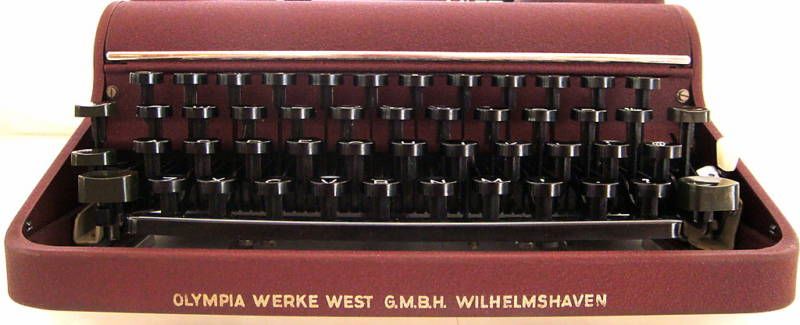
Photo: VintageTypewriterJewellery.com


Orbis? Who is this..... Orbis... 

The back of the typewriter was also quite revealing. Whereas the label on the back usually has the very familiar cursive 'Olympia' logo, this machine instead has 'Orbis' in its place. 


Other than the glossy crinkle paint, there were also some other substantially more significant differences between the machines. 

Firstly, the two typewriters have different platen knobs. The plastic on the maroon typewriter felt and looked different to the larger, but less well-made versions featured on my SM1. 


The Maroon typewriter has quite a different case, which is colour-matched to the machine. 


Also, the maroon version of this machine has a significantly different keyboard.


As you can see, they keys on the maroon machine are significantly thicker, and have a sharper edge around the ring. My original SM1 has keys that are identical to the older Progess/Simplex/Elite machines from prior to WW2.

The differences between the keys aren't cosmetic either. You may also be able to see that the metal tabs under the keys that slot perpendicularly to the type lever don't extend as far down as they do on the SM1. As it turns out the keys on the Maroon machine are a lot more complicated. They have several interlocking parts, and appear to facilitate the keys to spring, like what we are more familiar with on the SM3 and 4 machines. The keys themselves feel oddly weighted compared to the SM1.

Naturally my first response was to jam 'Orbis' into google to find out what on earth I had in my hands.

Unfortunately very little came up. And what did come up was a confusing mix of bit-parts. So I promptly hopped onto email and messaged the most knowledgable guy that I know, that probably isn't going to have a problem with me late-night work-fatigued lack of english language skills.

So I emailed Rob Messenger.

Rob didn't have a lot, but he had some interesting things to say about 'Orbis'. Between Rob and the other sources that I consulted, I eventually got a very vague picture about the history of this typewriter.

After WW2 the bulk of the Olympia design and engineering workers managed to have somehow gotten themselves over the border from East Germany and into the more business capital orientated West. Here they began to set up a new company to begin building typewriters again.

However, they appear to have faced a few barriers. Firstly, they had no money. They attempted to extract the capital that was related to the original Olympia interests in East Germany, but were reportedly thwarted at the last step. Secondly there was a tussle over who had the rights to use the 'Olympia' name. As such 'Orbis' was born. Orbis was a name that had been associated with the company before.

While the legal fight went on, the company started to produce typewriters. However the company must have seized control of the name early in manufacturing, and as such The machines ended up being badged 'Olympia'.

On the East German side Optima was formed, and they used existing designs to construct Olympia machines.

However the paper table gives away something about the history of the maroon machine. The 'Olympia' badge sits in an oddly recessed shape on the paper table, that looks like it is some kind of slot in plate. While I was doing some investigation into the 'Orbis', I found this photograph on Pinterest.

Photo: The Typewriter Workshop. 

This machine features the same carriage lever, keys, rubber feet and paper stand from the pre-WW2 machines, while it has the later crinkle paint, and at least 1 of the chrome strips. Note that the badge does not sit in a recessed section on the paper-table.

If you look at the typewriter database there is an Orbis model listed which was made for approximately a year - around 1949. This machine was reportedly over-engineered and significantly more costly than the prevailing SM1.

I don't have a lot of information about this era of machine, and a such it is open to conjecture about what machine is what. This becomes even more complicated when you discover 'Olympia  model Orbis' machines being advertised several years after the 1 year manufacturing period of the 'Orbis'.

From the 'Sydney Morning Herald' in March 1951. Similar ads featured in the newspaper until late 1952. The 'Royal Easter Show' is a large rural fair that occurs in Sydney every year. 

The machine in this photo appears - with a bit if eye-straining, to have the same platen knobs of the SM1, and the same keys. It is possible however that this is largely a over-stock line that was expensive and hard to sell in Sydney at the time before, they started selling SM labelled machines. But that is pure speculation. 


So, very little is clear about this maroon machine. But that doesn't detract from me enjoying it. Then again, I have suddenly found myself with a handful of Olympias, all of which are magnificent machines. 

But more about that later.... 

Thursday, November 7, 2013

So, tell me about this Carina 2 typewriter.


The Carina 2 is a very solid typewriter despite the plastic case, but is very light despite its size. Even when it is being kept in its interesting case. 


Saturday, October 19, 2013

I'd buy that for a dollar, or three.

I felt slightly jealous of some of the ultra-cheap typewriter finds that Ted and and a few other typewriter lovers recently posted about. Or at least until.... 

(pardon my sloppy english). 


The Adler.... It looks a little worn an beaten, but may prove to be an excellent typewriter yet. 

* * *

Oh, but it didn't end there... 


That's right. 12 typewriters. That makes them $3 each. The photos did not provide much in the way of information on these machines, as the seller had basically just crammed whatever he could into three photos without attempting to make any effort to display what he had. 

As such at least 4 of the typewriters were going to be a bit of a 'lucky dip' selection. But I did spot a very familiar case on one, that I was certain would make this worthwhile. 

The problem is, that my collection had already burst at the seams as it was. I just simply don't have storage space to put them. Suddenly adding another twelve to the mix is going to be interesting. 

The morning that the auction ended, I went over and collected the horde of machines and loaded them into Ruby the Exxy with the assistance of miss Jane. It was essentially a deceased estate, as these machines belonged to the seller's late father. 

"He was trying to fix them and sell them" the seller told me. "But I think he was asking too much for them or something". The seller was ex-army. He struck me as the kind of guy that would have been a 'plantie', an engineer that would operate or maintain heavy machinery used in construction. His car was adorned with army stickers, and the less tasteful  car 'breasticles', a variation of 'Truck testicles' that looked like breasts hanging from his tow-bar. 

Either way, the collective of machines were both filthy, and in disarray. A couple of the machines were flat-out just nasty, with wasp nests and rust giving the collection a texture that made one feel compelled to get a tetanus shot just for handling them. 

I had been emailing both John and Steve about these typewriters, and we'd agreed grab whatever we particularly wanted the most from the collection of machines. As I drove out from the seller's house, I called Steve and asked him if he would like to take a look. 

I laid out the collection on Steve's front lawn, and we were soon going over each machine with something of a cursory inspection. John had already expressed that he wanted the big Remington standard, and I wanted the particularly green coloured typewriter that I had spotted as just a case in the photos. 

More typewriters growing from Steve's lawn? 

No prizes for guessing which machine I gave my immediate preference to. 

As you can see, there's also a box of Adler branded ribbons. I have no idea as to what condition these are in, but I'm curious to find out. 

There was really only two machines that I at this stage feel are irretrievable. The rest of them I am certain can still have another life yet. But I may find some disasters await me when I start to have a much closer look. Either way, at $3 each typewriter, there's really nothing to cry about. 

The big Olivetti Studio even had its cover, and interestingly a list of songs that looked like it was for a country music christmas celebration. I immediately had the mental image of some RM Williams clad man with an Akubra hat on, tapping out the list of his favourites on that big ol' Olivetti. Trouble is that the machine's design had 'space age' written all over it, so far as it even had a 'techno' typeface. As such it just didn't seem to be the right typewriter for the part. Not to mention that a woman had signed off on the list with some christmas wishes. Not that women don't cruise around wearing RM's and big hats. 

Fragments of the past. Oh... hang on, there's some familiar names here.

Steve grabbed out of the collection an Olivetti 32, and a Underwood 310. I'm certain with a bit of a clean the 310 would come up looking quite beautiful with its striking cobalt blue ribbon cover and trim, and vibrant white shell. I think he's got a worthwhile machine there. 

We loaded the 10 other machines back into the car and Jane and I made our way home. I've now got 10 more typewriters that need assessing and, well, probably urgent attention, sitting in my shed. That's 11 typewriters in total this week from just the local countryside.

It must be fruit-pickin' season. 

Monday, October 7, 2013

Update... Backdate... Update... Sheepdate...


I've really neglected a few parts of my blog lately. I constantly forget to add to my 'Revered Typoverse' column down the right hand side of my page here, and I feel I've offended a few people by not adding their usually quite well written blogs.

A major mistake of mine was to not include the Davis Typewriter Works blog:
Davis typewriter works.


I read this blog anytime I see a new addition, and I've been really enjoying the videos that the guys have been putting up on Youtube. There is a real feel of energy between the Davis boys in their videos, and they present refreshingly well and the two of them just seem to bounce off each other.
Will Davis youtube channel. 
*  *  *

I was excited to learn last night that John Lavery has finally gotten around to starting his blog. He's put up a great write-up of his efforts to repair a Kmart typewriter. His blog is still a work in progress, and he informed me that he'll be including more pictures (and maybe video?) in the future. But right now, like all of us when we first started out blogs he's just finding his form. 

John has a lot of great knowledge and memories, and it is brilliant to see this being used in his blog. 

John's blog can be found here:-


I think we should give John plenty of support with his blogging adventures. He's got a lot of great stories to tell, and I think this is a great medium for him to tell them. 

*  *  *

Something I have also neglected is that brilliant website that Ted has put together that lets you search the Typosphere, check out people's typewriters and reference serial numbers to get an idea of the age of your machine. 

It is so much more than a serial number database. I had started to put together a list of my machines on there, but I haven't updated it in ages. It only reflects about half of my collection - and I've yet to get my more interesting machines photographed on there as yet. 

I think Ted has done a brilliant job thus far, and I thank him for the wonderful work that he's done. His site is so much easier to use than the previously ubiquitous TW-DB.

Here tis' 


*  *  *

I'll be trying to update more of your blogs onto my site whenever I can, but if you feel I have neglected yours - just drop me a line and say 'Hey, what about me'! Don't be shy. The typosphere is a great place to support each other, and if I haven't listed you - it isn't because I'm snobbing you. It is usually because my head is too far up my arse to have remembered to add you. 


Wednesday, September 25, 2013

The Remington man, and the blur of memories.

While I was in Melbourne, I set myself what I thought would be a simple task. I was to find a photograph of my my grandfather 'Scottie', who had been a typewriter mechanic for over 40 years.

However in doing so I made a discovery that left me re-thinking much of my families history, and made me confront some very difficult memories of my own.

But let's start at the beginning...

John Lavery couldn't picture my grandfather's face in his head. He knew the name, he knew him as one of the mechanics around Melbourne, and I knew a lot of the mutual mutual people that I had even met myself.

After all, I had been to the Adler workshop with my grandfather. I remember meeting the head mechanic of that workshop's son on several occasions as well. In fact, I have a whole host of memories of my own - even though I was very young, from Adler.

I arrived at my uncle's place mid evening, and he cooked up some dinner for me. My uncle in a lot of ways is a lot like myself, and he showed my some of the newer additions to some of his collections. We looked over his 50 something typewriters (almost all of them were standards, would you believe!) his Harley Davidson motorcycles, his GT Falcons, his P!NK memorabilia, and we soon got down to talking about family business.

The last of the great V8s. Such a brilliant car!

My grandmother passed away 3 years ago, and what little was left of her estate was tucked away in a room at my uncle's house in Melbourne. So it seemed only logical that I ask him if he had some photos of my grandfather.

A few beers were consumed for courage before my uncle delved into the spare room filled to the ceiling with my grandmother's belongings, and he soon returned with two photo filled shopping bags  that had been quickly stuffed with very little care.

He back sat down with a bit of an anxious huff, and started to pull photos from the bag.

"Do you have any of him at Adler by chance, at the workshop"? I asked casually.
"Ay"? My uncle enquired with confusion. "He never worked for Adler. He worked for Remington for 47 years"!

Honestly surprised, I then asked him "Really? Why did he drag my sister and I all the time to Adler, and why did he seem to always be mates with all the mechanics from there"?
"Oh no, he just went there for parts and stuff. Oh, and he bought heaps of typewriters from there. He used to sell them on to customers. He just went there because the typewriters were cheap and he had some mates there".

"Here, have a look at this" My uncle continued, as he handed me another photo as though he was emphasising a point. "I think this is me as a kid, standing in front of the Chartres service car"


I was stunned. I was certain he worked for Adler. Even my own father who would have surely known him for decades of his working life, had talked about him at Adler's workshops, and I struggled to make any sense of all of this. But the evidence was irrefutable - 'Scottie' was a Remington man. 

Scottie wasn't actually his name. He immigrated from Scotland in the 20's, and never lost the accent. If anything, the older he got the thicker the accent became. The nickname 'Scottie' apparently stuck very early on, and for some reason - despite there being thousands of immigrants from Scotland in Australia, he seemed to be 'Scottie' to pretty much everyone.

We shuffled on through the photos and soon came across some images taken from my Grandparent's wedding. My Grandmother looked astonishingly beautiful, and I realised that I knew very little about my grandparents lives prior to them starting a family.


My grandfather was a competitive ballroom dancer, and soccer player in his youth, and in the photographs the dancer in him was obvious, as he appeared incredibly comfortable in his suit. My grandmother also was very graceful in the photographs - but not as relaxed as my grandfather. However she had a pleasant glow of contentment and happiness about her. 

There were a couple of other photos that we just couldn't place the people in, so I started to ask my uncle about my Grandfather's own family. But he was to emotional about the photographs to really answer my questions, and he struggled to remember who key people in the photographs were. 


That's my grandfather ' Scottie' on the right. 

There was a life in some of these photos that just flowed from them - which gave me something of a feeling about how my grandparents lived their lives. And it really rubbed in how little I knew.


I guess it was inevitable though, that my own mother would start appearing in these photos. I'd never seen anything of my mother as a child before this, and to be honest I wasn't prepared for the very mixed feelings that I had about seeing her in these photos. 

My grandfather and my mother. I have no idea why she is glowing in this scan.

Most of my memories of my mother are blurred due to the emotional loading from my mother tragically suffering from Multiple Sclerosis for over 20 years. It is impossible to describe how such a thing impacts on your family, and it becomes very hard to look back into your past and find a lot of happy memories. But they are there - if I look hard enough.

My grandfather passed away in February 2003, and my mother followed three weeks later. I moved to Brisbane, away from Melbourne a year after that. 

Even now I find my eyes welling up as I write about this. So I'll just keep this brief.

But the world, and the young girl that would later be my mother, in these photos were different. There is a feeling, a feeling of hope for the future and the beauty of living, that I didn't expect. 


As a child my mother seemed so adorable. This was a far softer image of her than the woman of my memories, where I see the ferocious fighter who spent years lobbying politicians for better support for the disabled, while she struggled with her own deteriorating body. She was a woman that despite the bad lot she had been handed, was determined to make a difference in life, and held strong beliefs about social justice, and even before she had MS, she was a very strong campaigner for women's rights amongst other things.

So, in conclusion I have some photos of my grandfather to show John when I next see him, and I even managed to start a little bit of family in-fighting by just asking for these photos. But at least a bit of family fighting is a reminder that I still have a father, a sister and an uncle - and that they still mean a lot to me. 

Thank you for reading this far.

Saturday, September 14, 2013

The Brother that followed me home.

So how does an unusual and practically rare typewriter hide itself in plain sight in a typewriter shop?

By being a Brother 760TR. 


John Lavery informs me that the TR designation next to the 760 means "Tabulator and Repeater". The repeater is the repeat spacer button that you can see down on the bottom right hand side of the typewriter. A magnificent creation that works exceptionally well on this machine. 

As you would expect from Tom's shop, the machine is in brilliant working condition and it feels and writes like it is brand new. In fact it even looks new, bar the slightly worn feet. The cover that came with it doesn't match the machine's colour and the cover's lock was a bit stuffed, but honestly I didn't care too much about the cover as I can rip one of them off the several other million of these machines that I have seen floating about on eBay that often go cheap. I just wanted this typewriter. 


Confused? Are you asking yourself.. "Why would Scott want a plastic Japanese mass produced machine, that is far from rare, when he has so many other good Typewriters? I mean, even he admits there were millions of this machine produced".

If you just asked yourself that question or something like it, you just did exactly what I did when I glanced at this typewriter sitting a bit neglected on top of a pile of other bits and pieces in Tom's shop.

See it there, right next to Tom's elbow to the right? 

And no offence, if you haven't spotted it yet, you're not paying attention. Go back and have a look at the picture that is second down above. I mean.... have a really close look. See how there's only two colours on the ribbon selector? That's usually a give-away on this size machine that this is a script typewriter of some kind. 

...... hang on a second. That's script alright. 


Yep. It's an.... 

("Arabic typewriter"... sort of. I think I may have messed it up)
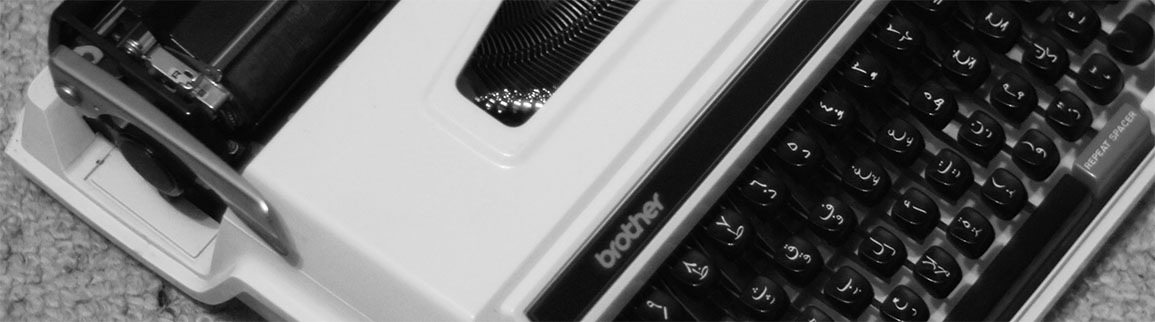

I've been after one of these for a little while. Have you tried doing a search on eBay for one? Nothing. Which is exactly the same thing that you get when you do a completed listings search as well. Richard Polt has had his hands on a couple, and Adowa also stumbled across one. But other than that these typewriters (at least in western countries) are exceedingly thin on the ground and the internet.

Actually, it goes further than that. While I haven't exactly explored Indonesia, friends of mine in Islamic countries have looked about, and have found that these are very hard to get their hands on and are quite sought after. Particularly in areas where there's intermittent power access, where they are invaluable. 

There's been some discussion about future employment possibilities in this household, and a little while ago I thought it might be a good idea to learn some Arabic - if anything to keep on contact with my friends overseas. Florian gave me an idea a little while back with his own blog, which he originally established to help him get a stronger grasp on the English language. And it occurred to me that I could very well do the same through a typewriter of my own. 

I can't read Arabic, but I have quite a history with it - enough to know that Arabic isn't just one language. When I first worked at the Queen Victoria Market in Melbourne, I used to work with a stall-holder that was from Pakistan. He was an odd little chap who didn't have a particularly elegant grasp of english, and was often finding himself in confrontation with customers due to what he believed was his lack of language skill. 

Actually, it turned out that it wasn't his language. He was just a dirty old man who had a crap attitude to women. This was problematic for someone that ran a store that sold women's clothing. 
At one stage he tried to teach me Arabic, but he was very impatient and the busy life of the market was not conducive to such things. So I never really learned. He eventually bought himself a little electronic Arabic to English dictionary - which is where I first saw an Arabic keyboard.


As I have discussed before the QVM was full of immigrants from pretty much everywhere. I got along with the old Italians and Greeks, and when I when I eventually quit with the Pakistani (in a spectacular explosion of foul language and insults from both sides) the Russians - particularly the Russian Jews were very welcoming. However the Market was also home to a lot of refugees from Islamic countries that were at the time in conflict.

Falling out with the Pakistani turned out to be fortuitous. In his own community he wasn't very well liked, and so generally Muslims and Israelis alike were quite friendly to me after that, and so I generally got along with almost all of the traders in the Market because of it.

A lot of the Muslims in the market were very religious, and as long as you respected that you got along with them well. The phrase 'but by the grace of god' was commonly used, and they were particularly poetic - if not romantic, in their phrasing when they spoke.

The written language itself is incredibly beautiful. Compared to boxy Chinese or the stone chiseled runes of my own celtic ancestors, the fluidity of Arabic writing underlies the broad minds that were at work when the language was first developed. Take the Qur'an for example: While it came out of the same part of the world as the bible, many of the stories told within it depict vivid and colourful places that are compellingly imaginative and inspiring, which leaves the christian text's tales looking decidedly dusty and dirty by comparison.

Arabs devised the pattern of numerals that we are familiar with today: 0,1-9. Previously 0 as a numeral did not exist. On the keyboard itself the numbers are shifted and placed along the top row of the keyboard. Do some of these look familiar? (read right to left) 

The squarish dot on the right is 0, and 1 and 9 are obvious. That reversed 3 looking thing is actually a 4 - and is a depiction of 4 squiggled lines, while that O looking character in the middle there is actually near diamond shaped, and is a 5. I'd seen plenty of Arabic numerals before, as the Pakistani from the market used to write out prices for items he sold in his little notebook for the bookkeeping he did at home. 

All Arabic writing is from right to left, and as such the typewriter itself writes that way. While Teeritz and I were playing with the typewriter in Tom's shop, Teeritz commented about how weird it seemed to have the carriage go the other direction. We had a bit of a laugh over the operation of the machine, as it seemed to feel so contrary to typewriters we were used to. 

It took Tom to point out that it was an Arabic Typewriter. Prior to that I just simply hadn't have spotted it, and had dismissed it on a cursory glance for being just another Brother plastic. Now that I have it in my hands I am actually surprised by how good a quality machine this actually is, compared to other Machines of its era.

However I didn't immediately buy the machine. As it was a Brother, I instantly felt a bit weird about paying a fair bit more than the usual price that I see Brother machines sell for. But I thought about it for a bit, and went back the next day to buy the typewriter. After all, as I have pointed out these typewriters are very thin on the ground. 

I don't have any affinity with Arabic particularly, and I'm certainly not a muslim. But I am interested in learning the language, so I just simply couldn't leave this typewriter behind. Maybe I should write my own Florian-esque blog in addition to this one, while learning. I might end up with a new audience. 

That said, I think I am still going to try and find a more classical piece like Richard's Olympia or Erika. Those typewriters are as beautiful as the language that is being written on them. But that's just me... I collect my machines for their beauty.